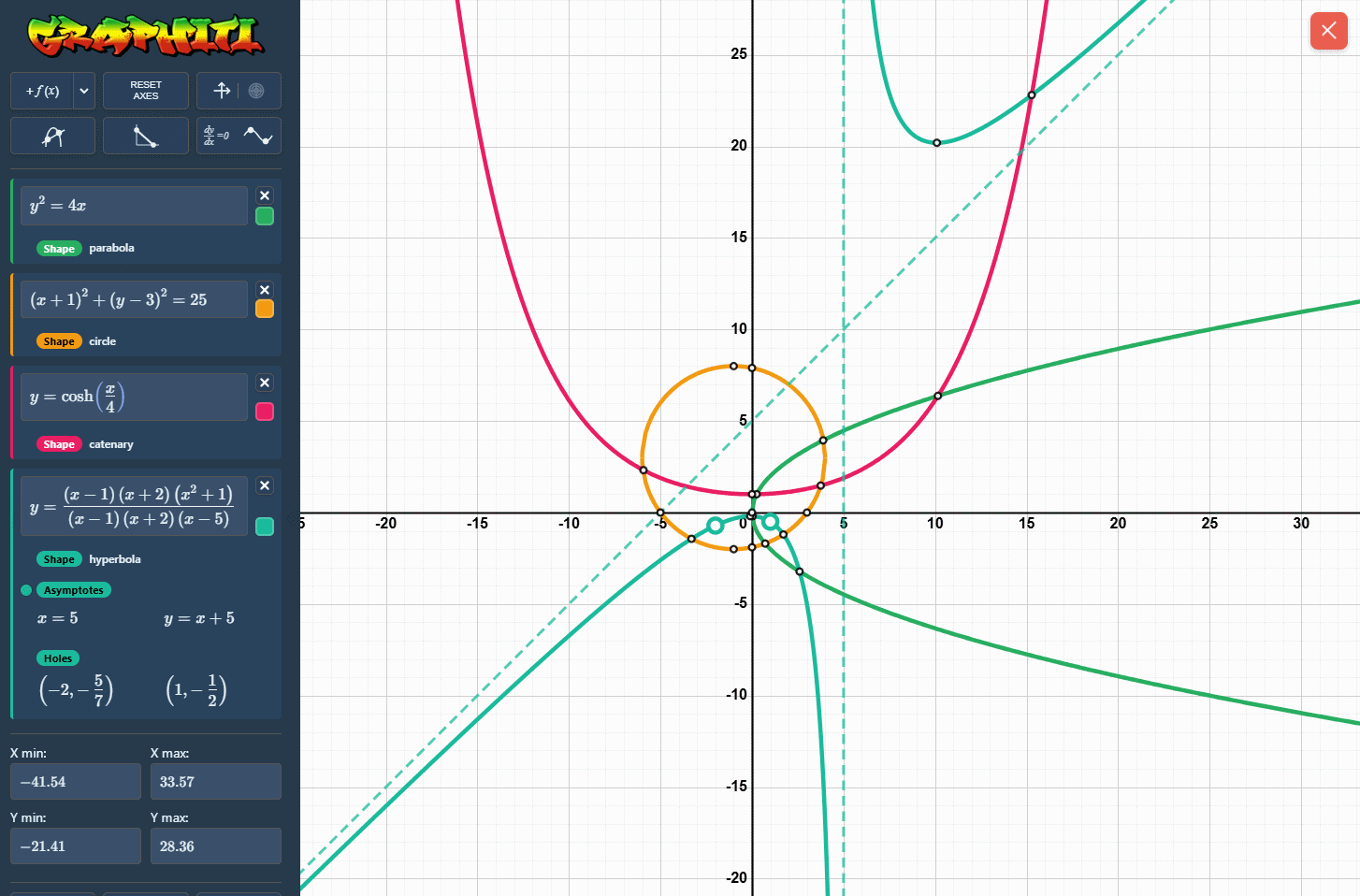
What kinds of curves can Graphiti identify?
- Conics and linear forms: circle, ellipse, parabola, hyperbola, rectangular hyperbola, line, line pair, and degenerate conic forms.
- Polar curves: rose curves, cardioids, limacons (inner loop, dimpled, convex), lemniscates of Bernoulli, logarithmic spirals, hyperbolic spirals, Fermat spirals, lituus, conchoid of Nicomedes, sinusoidal spirals, circles, and Archimedean spirals.
- Named and structured curves: folium of Descartes, scaled folium of Descartes, semi-cubical parabola, reciprocal-square curves, reciprocal-power curves, and catenaries.
- Implicit equations with multiple components, for example circle + line or line + parabola in product-form equations.
- Parametric curve families, including line, circle, ellipse, parabola, hyperbola, semi-cubical parabola, and folium forms.
Built for students, teachers and fast curve lookup
When students ask what shape an equation produces, Graphiti helps them move quickly from expression to named graph. It can distinguish common exam questions such as parabola versus circle, identify conic forms, and classify many polar and implicit examples directly from the input equation.
For teachers, Graphiti works as a practical curve classification tool in lessons and revision sessions, including implicit and polar curve identification. It is also useful when you need automatic curve recognition for shared examples, model answers, or quick checks while building tasks.
If you are searching for a graphing calculator that can name curves automatically, Graphiti provides equation-to-curve identification across multiple plotting modes and combines this with asymptote analysis where relevant.